+
PSALM
XXVII
New King James Version
An Exuberant Declarationof Faith
A Psalm of David.
The Lord is my light and my salvation;
Whom shall I fear?
The Lord is the strength of my life;
Of whom shall I be afraid?
When the wicked came against me
To eat up my flesh,
My enemies and foes,
They stumbled and fell.
Though an army may encamp against me,
My heart shall not fear;
Though war may rise against me,
In this I will be confident.
One thing I have desired of the Lord,
That will I seek:
That I may dwell in the house of the Lord
All the days of my life,
To behold the beauty of the Lord,
And to inquire in His temple.
For in the time of trouble
He shall hide me in His pavilion;
In the secret place of His tabernacle
He shall hide me;
He shall set me high upon a rock.
And now my head shall be lifted up above my enemies all around me;
Therefore I will offer sacrifices of joy in His tabernacle;
I will sing, yes, I will sing praises to the Lord.
Hear, O Lord, when I cry with my voice!
Have mercy also upon me, and answer me.
When You said, “Seek My face,”
My heart said to You, “Your face, Lord, I will seek.”
Do not hide Your face from me;
Do not turn Your servant away in anger;
You have been my help;
Do not leave me nor forsake me,
O God of my salvation.
When my father and my mother forsake me,
Then the Lord will take care of me.
Teach me Your way, O Lord,
And lead me in a smooth path, because of my enemies.
Do not deliver me to the will of my adversaries;
For false witnesses have risen against me,
And such as breathe out violence.
I would have lost heart, unless I had believed
That I would see the goodness of the Lord
In the land of the living.
Wait on the Lord;
Be of good courage,
And He shall strengthen your heart;
Wait, I say, on the Lord!
DAV I D
A man after God’s Heart who did All the will of God.
-
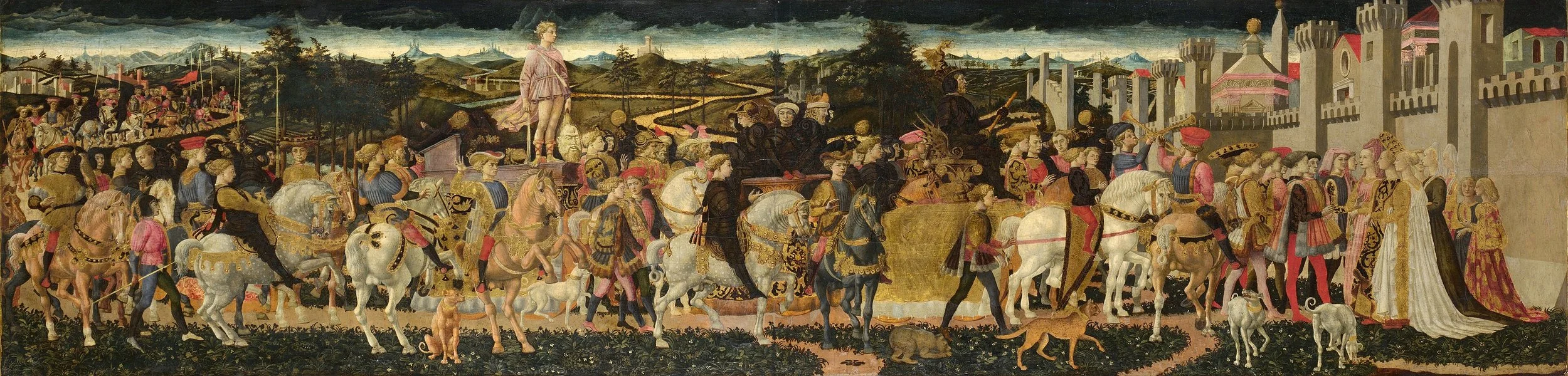
The Triumph of David by Francesco Pesellino
A fantastic procession winds its way through a Tuscan landscape dotted with hills and walled towns. Like its pair, The Story of David and Goliath, the whole scene is crammed with activity. Trumpeters play and extravagantly dressed nobles ride prancing horses, while their hounds, a cheetah and a bear trot along beside them (during the Renaissance cheetahs were kept for hunting).
This pair of long paintings probably decorated a bed chamber in fifteenth-century Florence. Painted by Francesco Pesellino, their dimensions suggest that these panels were spalliere, pictures set into the panelling of a domestic interior, usually at shoulder height, above chests or seating. They were perhaps made for the Medici to commemorate a wedding. The family are known to have had paintings by Pesellino.
Images of parades and processions were very well suited to this type of panel. Although it looks like fifteenth-century Italy, the story comes from the Old Testament. This is David’s return to Jerusalem after killing the Philistine giant Goliath, an enemy of Israel. He stands proudly, holding Goliath’s head by the hair, the body slung on the cart behind him. The bloody stump of the giant’s neck is visible between his feet. Saul, King of Israel, leads the procession towards the walled city of Jerusalem. He wears armour and a crowned helmet decorated with a dragon.
Like his contemporary Paolo Uccello, Pesellino was intensely interested in showing animals, especially horses, in movement. The very emphatically male horses here are shown at a variety of angles – from the side, from the front, from behind – and in various poses. The way the muscles and heads are painted suggests he was working from drawings from life, like Pisanello, although occasionally the arrangement of legs is inaccurate and he may well also have been looking at equestrian sculptures too.
At the far right outside the walls a betrothal is taking place: a young man in contemporary Florentine costume is being presented to a young woman and her companions. This could be an allusion to David and Michal, Saul’s daughter, who fell in love with David and married him or, more probably, the couple for whom the paintings were intended.

AWAKE
The TRIUMPH of DAIViD
The STORY of David and GOliath
This long and fantastically detailed painting is a precious survivor of Renaissance interior decoration – and it gives us an idea of just how spectacular this could be. It is one of a pair telling the story of David, King of Israel, who started life as a shepherd boy but rose to fame and fortune through killing the giant Goliath.
In the centre we see David, in pink, swinging his sling, taking aim at the armoured Goliath, whose forehead is already bleeding. In the foreground David beheads the fallen giant. The complex composition is linked by the stream: it flows from left to right, in and out of the panel, joining the most important incidents.
The painting, together with its pair also in the National Gallery’s collection, were doubtless made to commemorate a marriage, possibly of a member of the Medici, the ruling family of fifteenth-century Florence.
AWAKE
“After removing Saul, he made David their king. God testified concerning him: ‘I have found David son of Jesse, a man after my own heart; he will do everything I want him to do.’”
-
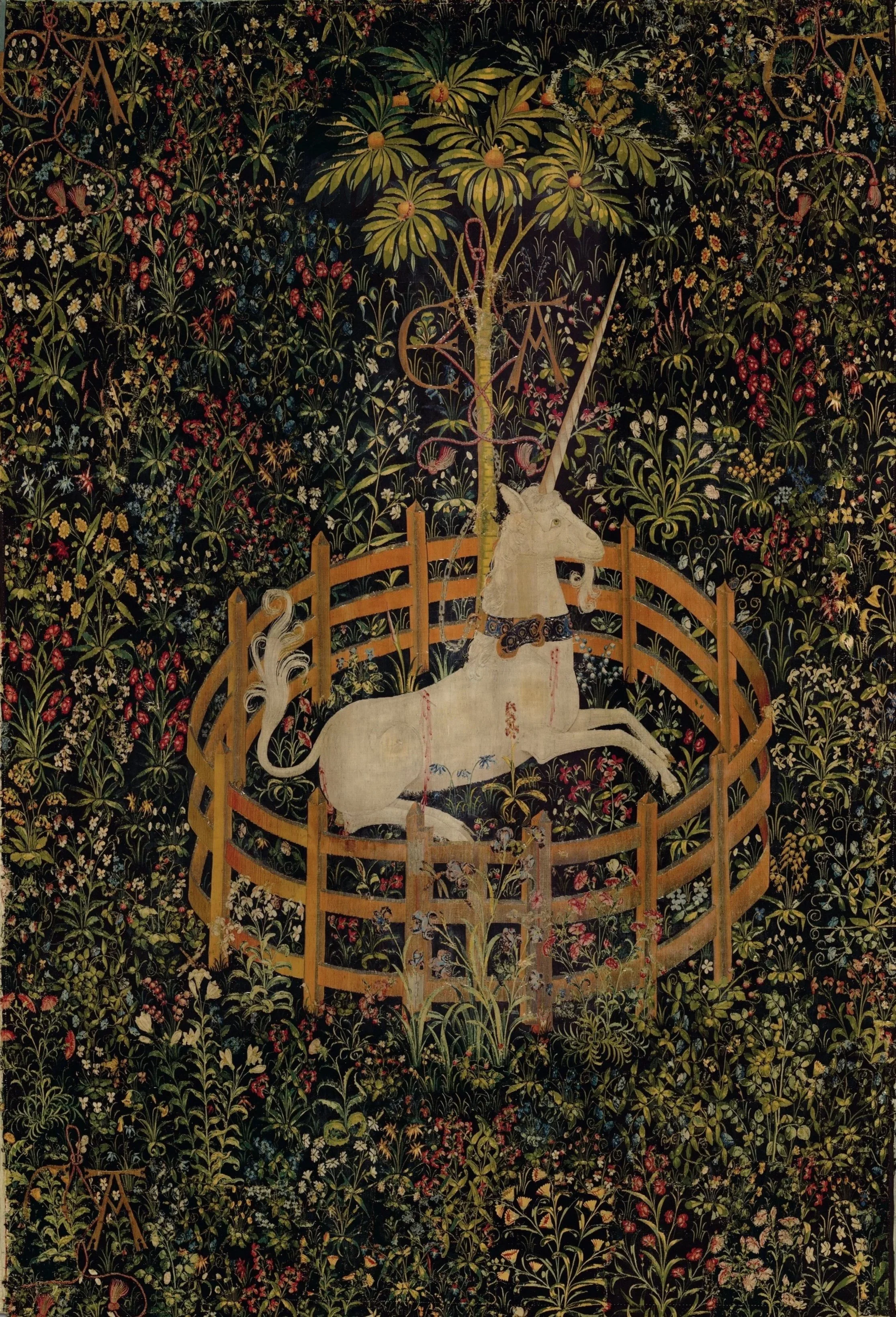
The Unicorn Rests in a Garden (from the Unicorn Tapestries)
French (cartoon)/South Netherlandish (woven)
On view at The Met Cloisters in Gallery 17
The seven individual hangings known as "The Unicorn Tapestries," are among the most beautiful and complex works of art from the late Middle Ages that survive. Luxuriously woven in fine wool and silk with silver and gilded threads, the tapestries vividly depict scenes associated with a hunt for the elusive, magical unicorn.
"The Unicorn Rests in a Garden" may have been created as a single image rather than part of a series. In this instance, the unicorn probably represents the beloved tamed. He is tethered to a tree and constrained by a fence, but the chain is not secure and the fence is low enough to leap over: The unicorn could escape if he wished. Clearly, however, his confinement is a happy one, to which the ripe, seed-laden pomegranates in the tree—a medieval symbol of fertility and marriage—testify. The red stains on his flank do not appear to be blood, as there are no visible wounds like those in the hunting series; rather, they represent juice dripping from bursting pomegranates above. Many of the other plants represented here, such as wild orchid, bistort, and thistle, echo this theme of marriage and procreation: they were acclaimed in the Middle Ages as fertility aids for both men and women. Even the little frog, nestled among the violets at the lower right, was cited by medieval writers for its noisy mating.


+
The SONG
of Songs IV
New King James Version
The Bridegroom Praises The Bride
The Beloved
Behold, you are fair, my love!
Behold, you are fair!
You have dove’s eyes behind your veil.
Your hair is like a flock of goats,
Going down from Mount Gilead.
Your teeth are like a flock of shorn sheep
Which have come up from the washing,
Every one of which bears twins,
And none is barren among them.
Your lips are like a strand of scarlet,
And your mouth is lovely.
Your temples behind your veil
Are like a piece of pomegranate.
Your neck is like the tower of David,
Built for an armory,
On which hang a thousand bucklers,
All shields of mighty men.
Your two breasts are like two fawns,
Twins of a gazelle,
Which feed among the lilies.
Until the day breaks
And the shadows flee away,
I will go my way to the mountain of myrrh
And to the hill of frankincense.
You are all fair, my love,
And there is no spot in you.
Come with me from Lebanon, my spouse,
With me from Lebanon.
Look from the top of Amana,
From the top of Senir and Hermon,
From the lions’ dens,
From the mountains of the leopards.
You have ravished my heart,
My sister, my spouse;
You have ravished my heart
With one look of your eyes,
With one link of your necklace.
How fair is your love,
My sister, my spouse!
How much better than wine is your love,
And the scent of your perfumes
Than all spices!
Your lips, O my spouse,
Drip as the honeycomb;
Honey and milk are under your tongue;
And the fragrance of your garments
Is like the fragrance of Lebanon.
12 A GARDEN enclosed
Is my sister, my spouse,
A spring shut up,
A fountain sealed.
Your plants are an orchard of pomegranates
With pleasant fruits,
Fragrant henna with spikenard,
Spikenard and saffron,
Calamus and cinnamon,
With all trees of frankincense,
Myrrh and aloes,
With all the chief spices—
A fountain of gardens,
A well of living waters,
And streams from Lebanon.
The Shulamite
Awake, O north wind,
And come, O south!
Blow upon my garden,
That its spices may flow out.
Let my beloved come to his garden
And eat its pleasant fruits.
-
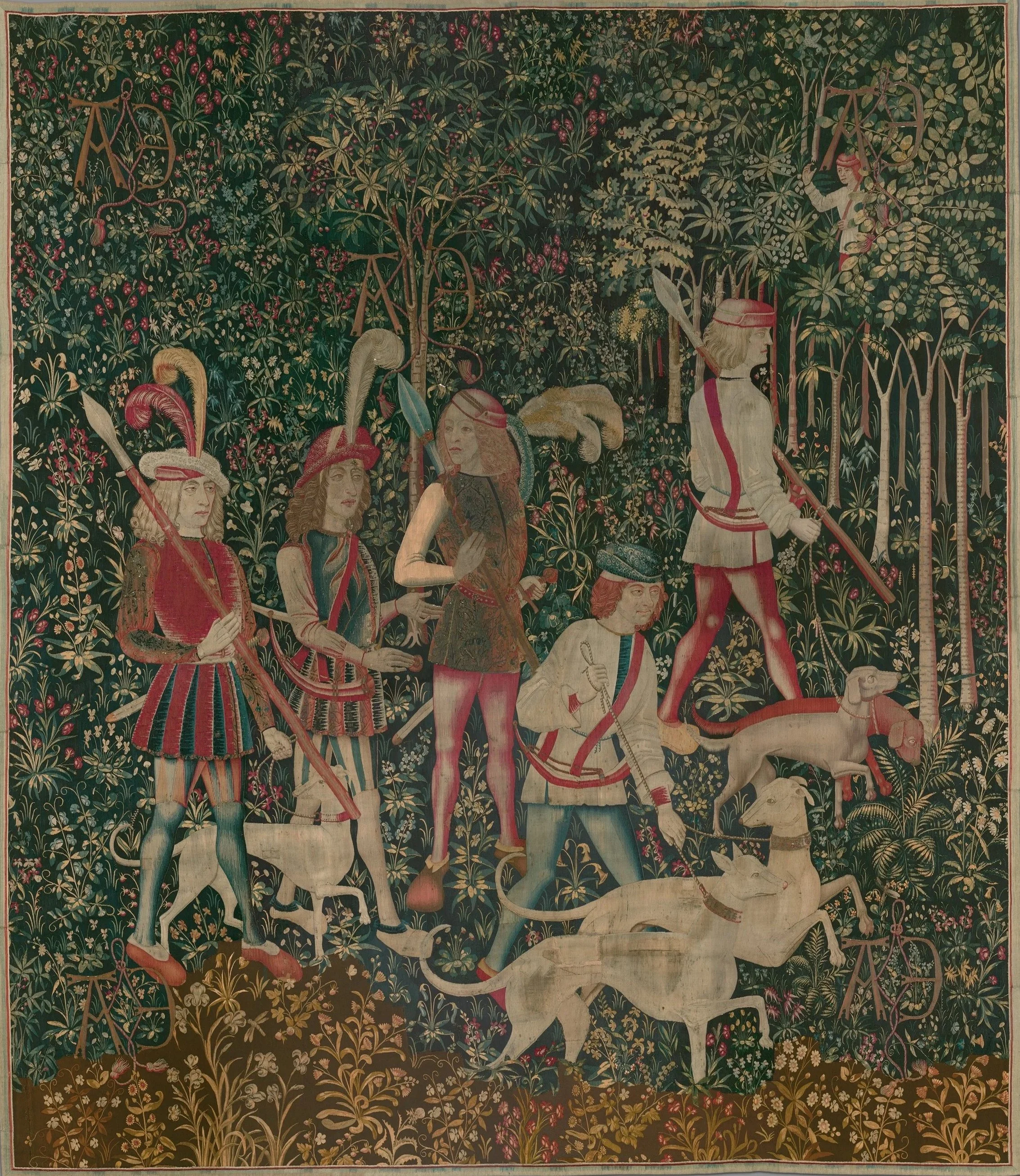
I. The Hunters Enter the Woods (from the Unicorn Tapestries)
French (cartoon)/South Netherlandish (woven)
On view at The Met Cloisters in Gallery 17
This tapestry is one of seven hangings at The Cloisters that depict the hunt of the unicorn, a mythical creature first mentioned by the Greek physician Ctesias in the fourth century B.C. In the Middle Ages the animal was best known for its supposed invincibility and for the therapeutic property of its horn. So strong was the belief in the horn's miraculous cures that by the twelfth century the tusks of male narwhals, a small whale native to the Arctic, came to be regarded as "unicorn horns."
The Unicorn Tapestries, as the group of seven is known, were probably designed in Paris but woven in Brussels. They are first documented in 1680, when they hung in the Paris home of François VI de La Rochefoucauld. By 1728 five of them decorated a bedroom at the family's château in Verteuil, in western France. The tapestries were looted during the French Revolution but were recovered in the 1850s; by 1856 they had been restored and rehung in the château's salon. No documentation sheds light on the early history of the tapestries, including either their commission or sequence of hanging. Striking differences in dimension and composition have prompted scholars to question whether the hangings constitute one set or are, in fact, from multiple sets.
The Hunters Enter the Woods, like The Unicorn in Captivity, is set against a millefleurs background: a field of dark green spangled with blossoming trees and flowers. Of the 101 species of plants represented, 85 have been identified, including the prominent cherry tree behind the hunters and lush date palm in front of the sniffing hound. The cipher "AE" that is woven into each of the Unicorn Tapestries—and repeated here five times—alludes to their original owners, who remain unknown.II.
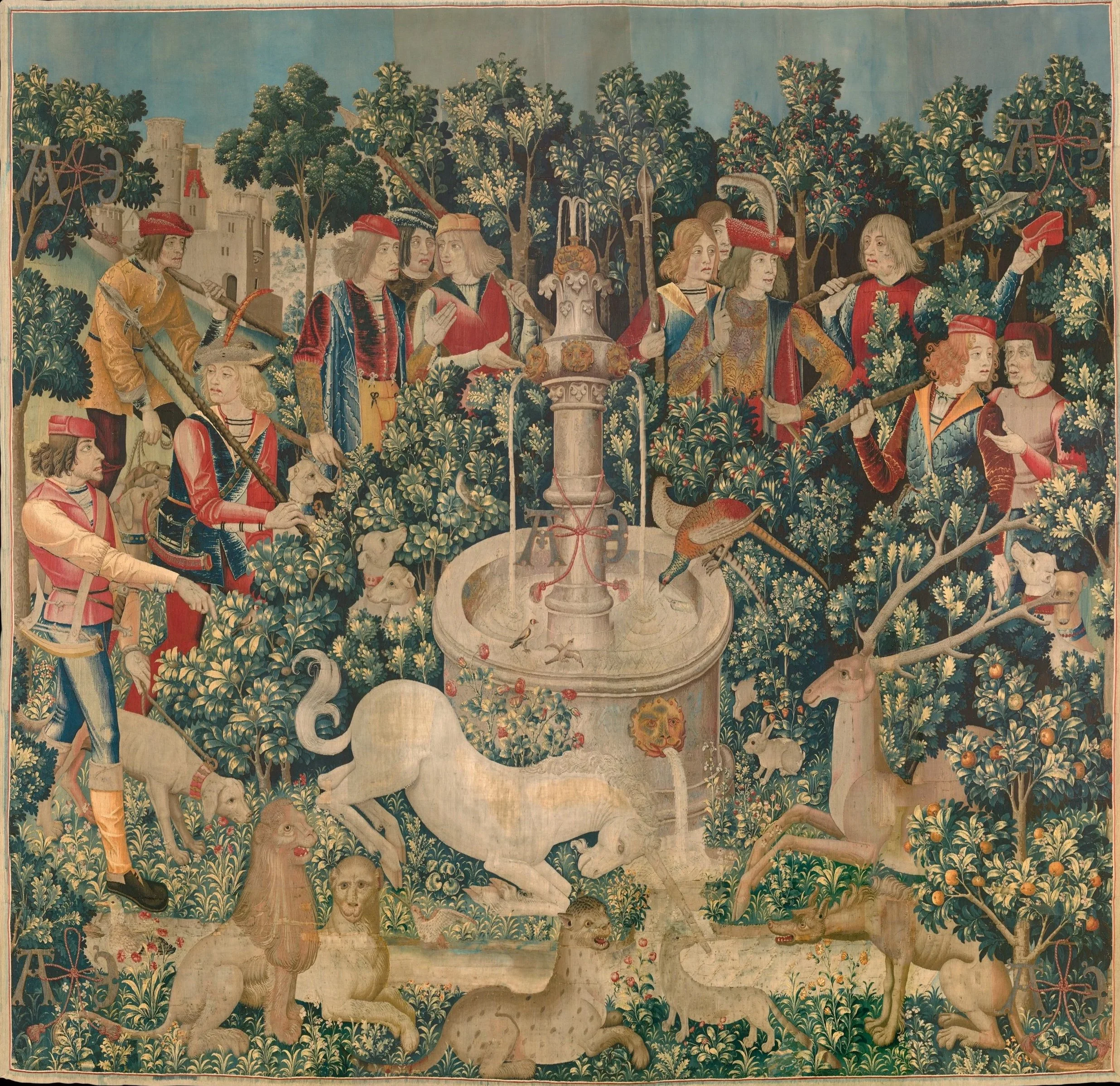
The Unicorn Purifies Water (from the Unicorn Tapestries)
French (cartoon)/South Netherlandish (woven)
On view at The Met Cloisters in Gallery 17
In this tapestry the unicorn kneels before a tall white fountain that has a pair of pheasants and a pair of goldfinches perched on its edge. Other animals both exotic and native to Europe lounge about, while twelve hunters in the back of the scene discuss the discovery of their quarry. Flora and fauna play a significant role in the narratives of the Unicorn Tapestries. Plants prescribed in medieval herbals as antidotes to poisoning, such as sage, pot marigolds, and orange, are positioned near the stream, which is being purified by the unicorn's magic horn.
III.
The Unicorn Crosses a Stream (from the Unicorn Tapestries)
French (cartoon)/South Netherlandish (woven)
On view at The Met Cloisters in Gallery 17
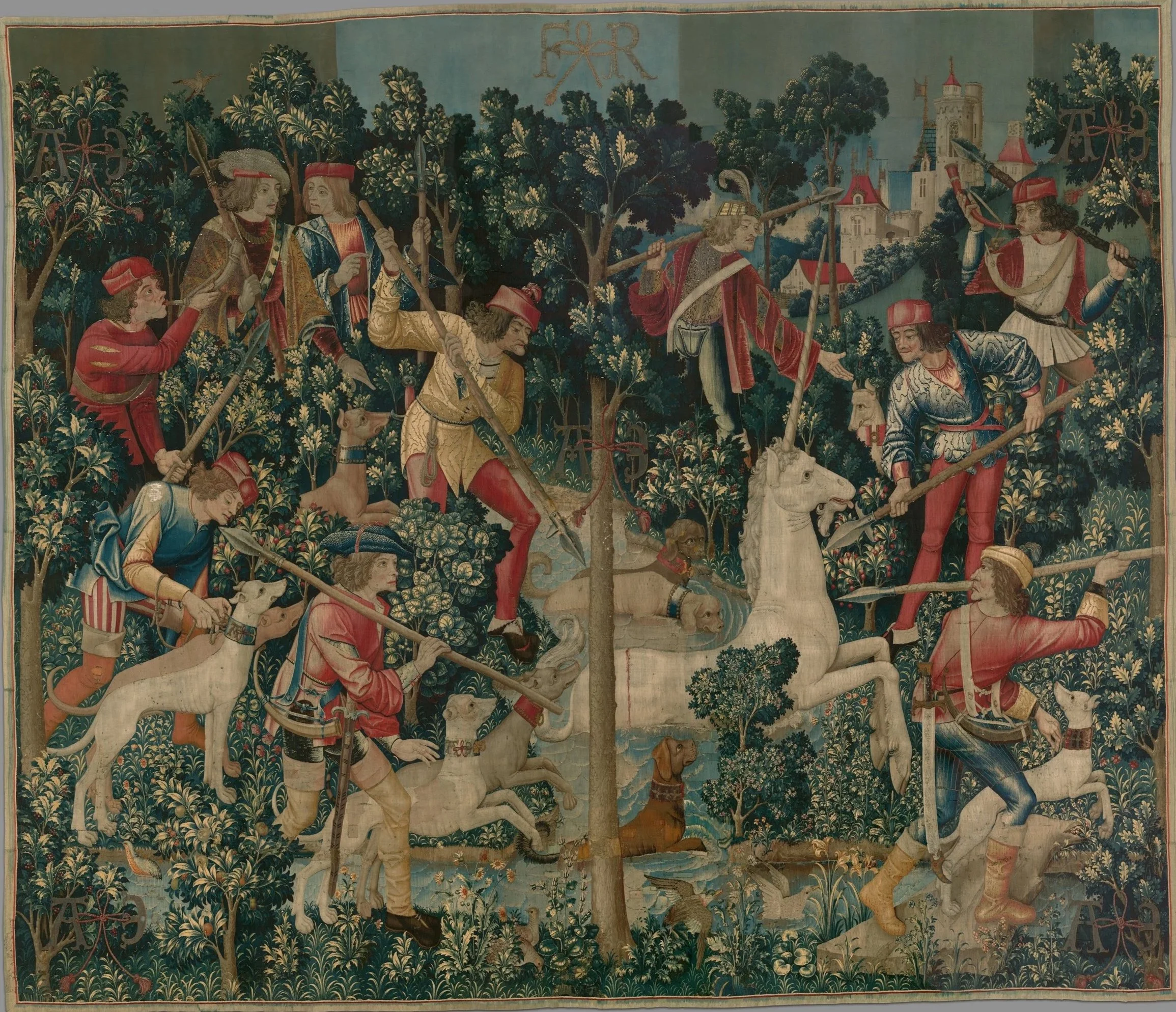
According to tradition, the unicorn cannot be disturbed while performing a magical act. The attack by the hunters thus presumably begins soon after the action depicted in The Unicorn Is Found, and the scene is one filled with chaos and commotion. The ferocity of the battle is conveyed by the converging lances aimed at the animal, the sounding of the hunting horns, and the menacing hounds. Already wounded on his back, the unicorn leaps across a stream in a desperate attempt to escape his encircling enemies.
The use of hounds to scout, chase, and eventually attack the quarry was typical practice in medieval stag hunts, and the palatial buildings in the background might be a further allusion to the hunt as a royal or aristocratic pastime. Unlike The Hunters Enter the Woods and The Unicorn in Captivity, this and the other hangings are set in realistic landscapes that enhance the drama of the hunt.IV.
The Unicorn Defends Himself (from the Unicorn Tapestries)
French (cartoon)/South Netherlandish (woven)
On view at The Met Cloisters in Gallery 17
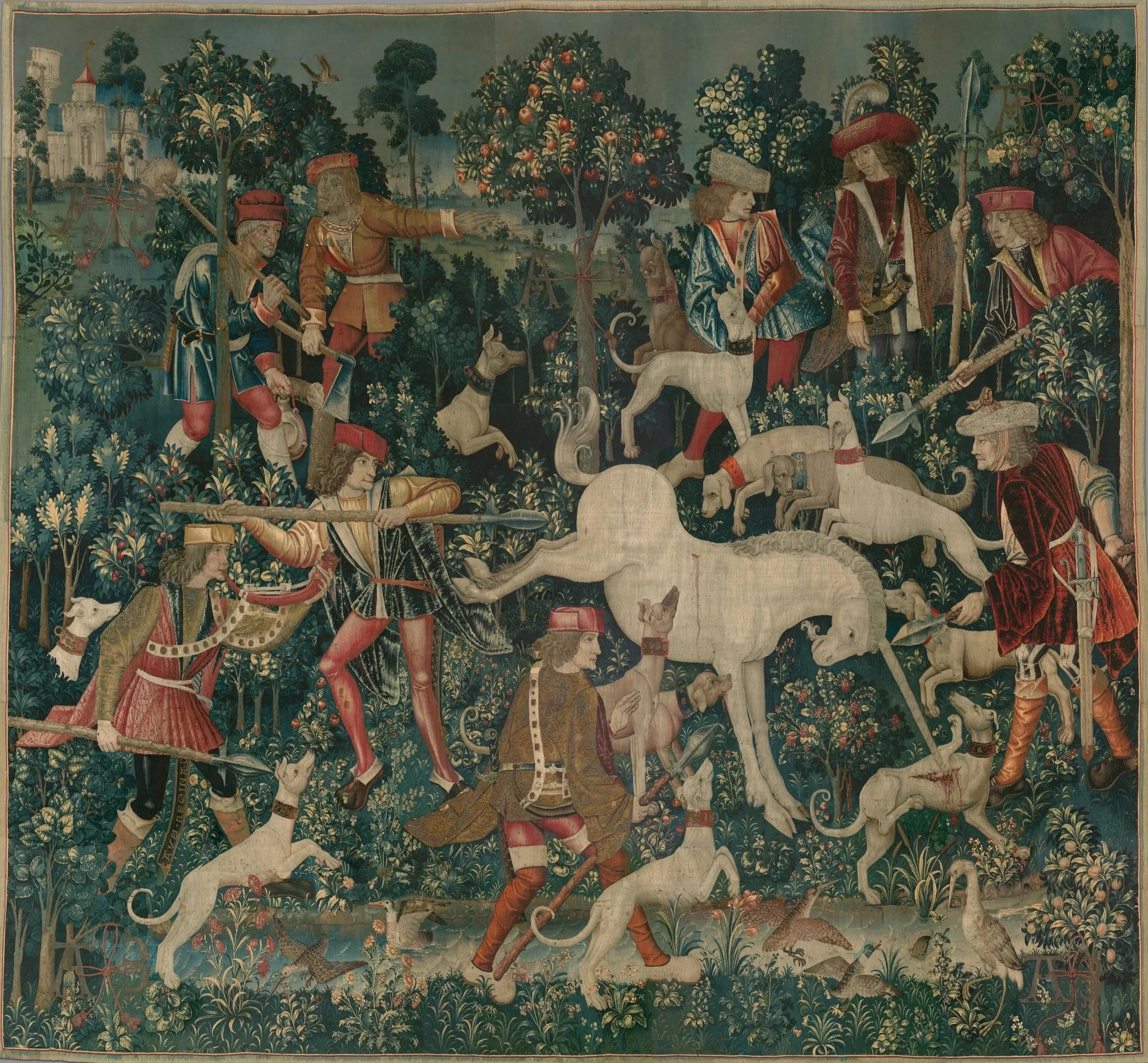
Here the injured unicorn is being held at bay by three hunters ready to pierce him with their lances. The furious animal reacts with a gruesome attack on a greyhound before him, almost tearing the dog's body apart. The horn-blowing hunter at the lower left wears a scabbard with the inscription AVE REGINA C[OELI] (Hail, Queen of the Heavens). The huntsmen and other figures are garbed in the fashions of about the turn of the sixteenth century, including round-toed shoes and fitted bodices, and their headdresses and hairstyles also reflect contemporary tastes. The mastery of the weavers is evident in the convincing representation of different materials and textures in the costumes, such as brocade, velvet, leather, and fur.
In order to make the tapestries, plain wool yarns (the warp) were stretched between two beams of a large loom; a bobbin then brought dyed and metallic threads (the wefts) over and under the warp threads to create the design. Chemical analyses reveal that the dye pigments used in the Unicorn Tapestries came from such plants as weld (yellow), madder (red), and woad (blue), all of which are grown in the Bonnefont Cloister garden. With the aid of mordants, substances that help fix the dyes to fabric, these three primary colors were blended to achieve a dazzling spectrum of hues strategically highlighted by the addition of metallic threads.V.
The Unicorn Surrenders to a Maiden (from the Unicorn Tapestries)
French (cartoon)/South Netherlandish (woven)
On view at The Met Cloisters in Gallery 17
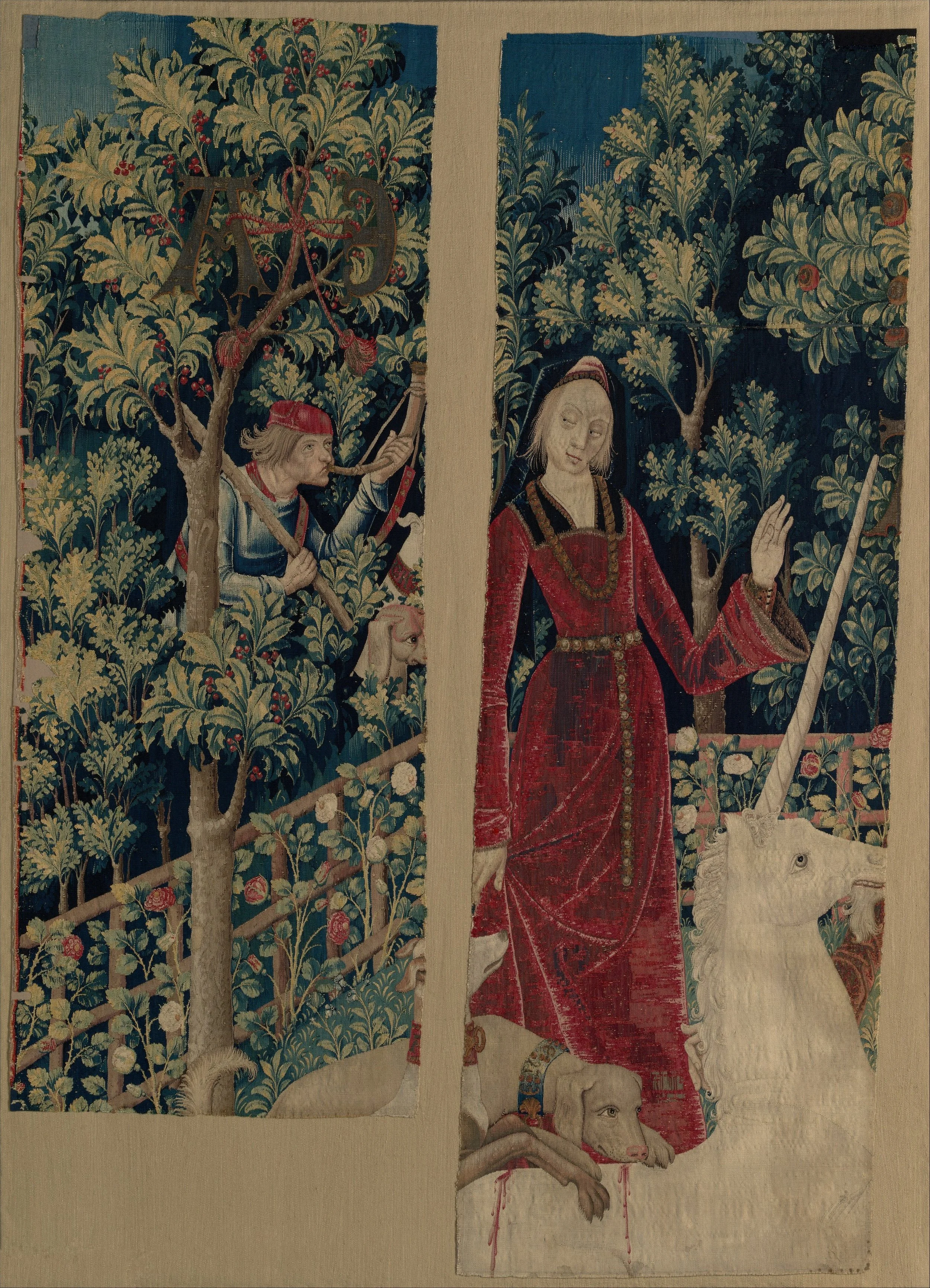
In these two fragments of a single tapestry (see also 38.51.2), the unicorn appears to have been tamed. He seems so docile, in fact, that he is oblivious to the dog licking the wound on his back and stares loving at the maiden who must have subdued him. Most of her figure is missing, the result of damage incurred after the tapestries were looted in 1793. The remaining traces include the maiden's right arm, clothed in red velvet and visible between the beard and throat of the unicorn, and her fingers, seen gently caressing the bottom of the animal's mane. She sits in an enclosed garden (hortus conclusus), often a metaphor for the purity of a maiden. The more complete female figure may be signaling to the hunter outside the garden, who in turn sounds the horn to summon the others.
VI.
The Hunters Return to the Castle (from the Unicorn Tapestries)
French (cartoon)/South Netherlandish (woven)
On view at The Met Cloisters in Gallery 17
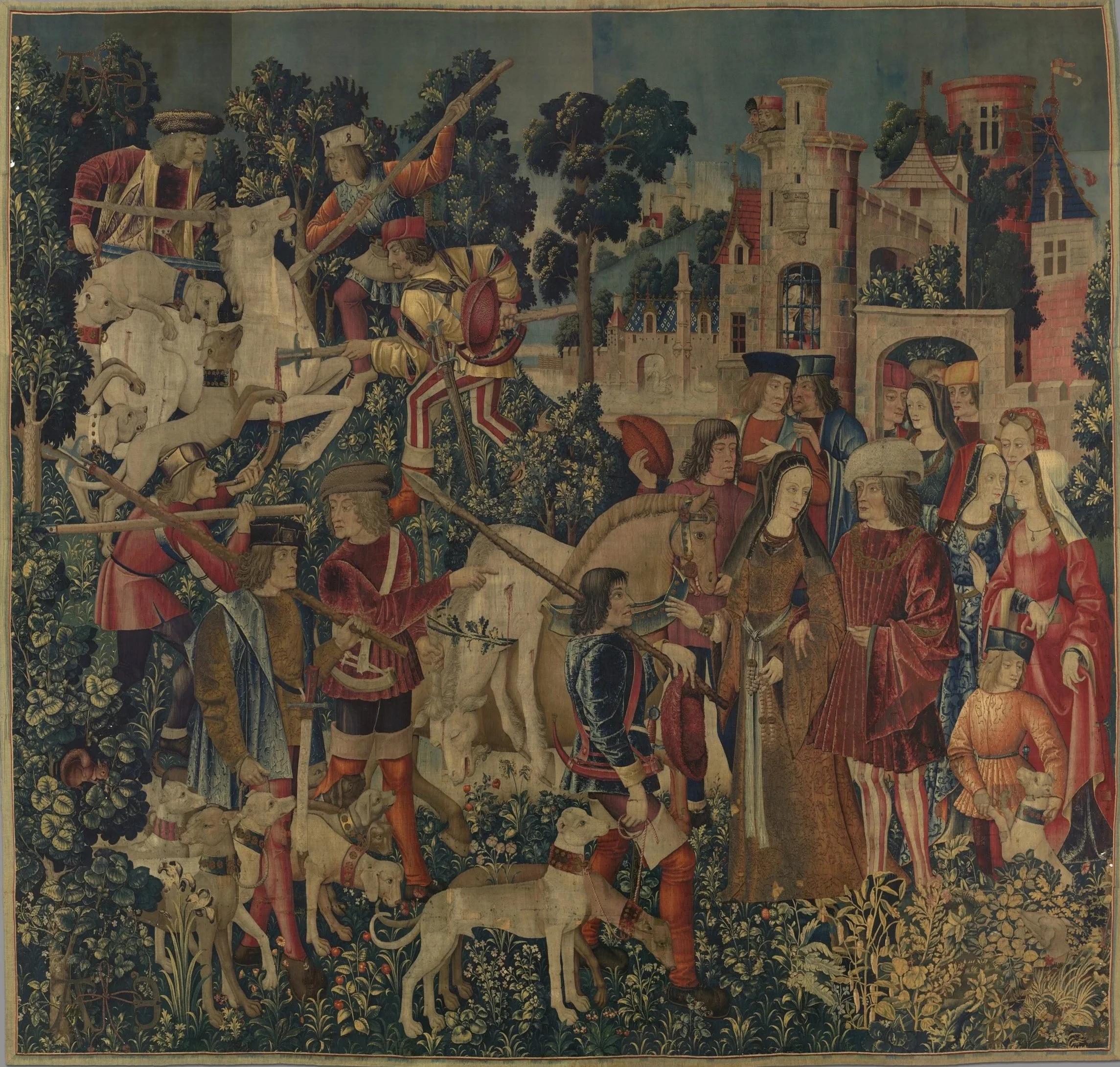
Two episodes of the hunt narrative are brought together in this hanging. At left, two hunters drive their lances into the neck and chest of the unicorn, as a third delivers the coup de grâce from the back. In some contexts, the unicorn is an allegory for Christ; the large holly tree (often a symbol of Christ's Passion) rising from behind his head may conceivably be linked to this association. In the other episode, at right, a lord and a lady receive the body of the unicorn in front of their castle. They are surrounded by their attendants, with more curious onlookers peering through windows of the turret behind them. The dead animal is slung on the back of a horse, his horn already cut off but still entangled in thorny oak branches—perhaps an allusion to the Crown of Thorns.
VII.
The Unicorn Rests in a Garden (from the Unicorn Tapestries)
French (cartoon)/South Netherlandish (woven)
On view at The Met Cloisters in Gallery 17
The seven individual hangings known as "The Unicorn Tapestries," are among the most beautiful and complex works of art from the late Middle Ages that survive. Luxuriously woven in fine wool and silk with silver and gilded threads, the tapestries vividly depict scenes associated with a hunt for the elusive, magical unicorn.
"The Unicorn Rests in a Garden" may have been created as a single image rather than part of a series. In this instance, the unicorn probably represents the beloved tamed. He is tethered to a tree and constrained by a fence, but the chain is not secure and the fence is low enough to leap over: The unicorn could escape if he wished. Clearly, however, his confinement is a happy one, to which the ripe, seed-laden pomegranates in the tree—a medieval symbol of fertility and marriage—testify. The red stains on his flank do not appear to be blood, as there are no visible wounds like those in the hunting series; rather, they represent juice dripping from bursting pomegranates above. Many of the other plants represented here, such as wild orchid, bistort, and thistle, echo this theme of marriage and procreation: they were acclaimed in the Middle Ages as fertility aids for both men and women. Even the little frog, nestled among the violets at the lower right, was cited by medieval writers for its noisy mating.
“Awake, O sleeper, arise from the dead, and Christ will shine on you.”
COME
INTO
YOUR
GARDEN
COME INTO
YOURGARDEN
COME INTO
YOURGARDEN
COME I N TO
YOUR GARDEN
COME I N TO
YOUR GARDEN
CO M e iN TO
YOURGARDEN
CO M e iN TO
YOUR GARDEN
CO M e iN TO
YOUR GARDEN
COME INTO YOUR GARDEN
COME I N T O
YOURGARDEN
“And He that sat upon the throne said, “Behold, I make all things new. And He said unto me, Write: for these words are true and faithful.””
DAVID is THE VICTOR